
How IPL Stadium Lighting Works: Engineering Behind the Bright Nights
What separates a dropped catch from a one handed screamer under the floodlights at 9 PM in a packed IPL stadium, with the ball racing at 140 kph?
It’s not just skill or luck. It’s engineered visibility & precision lighting that turns night into near day conditions.
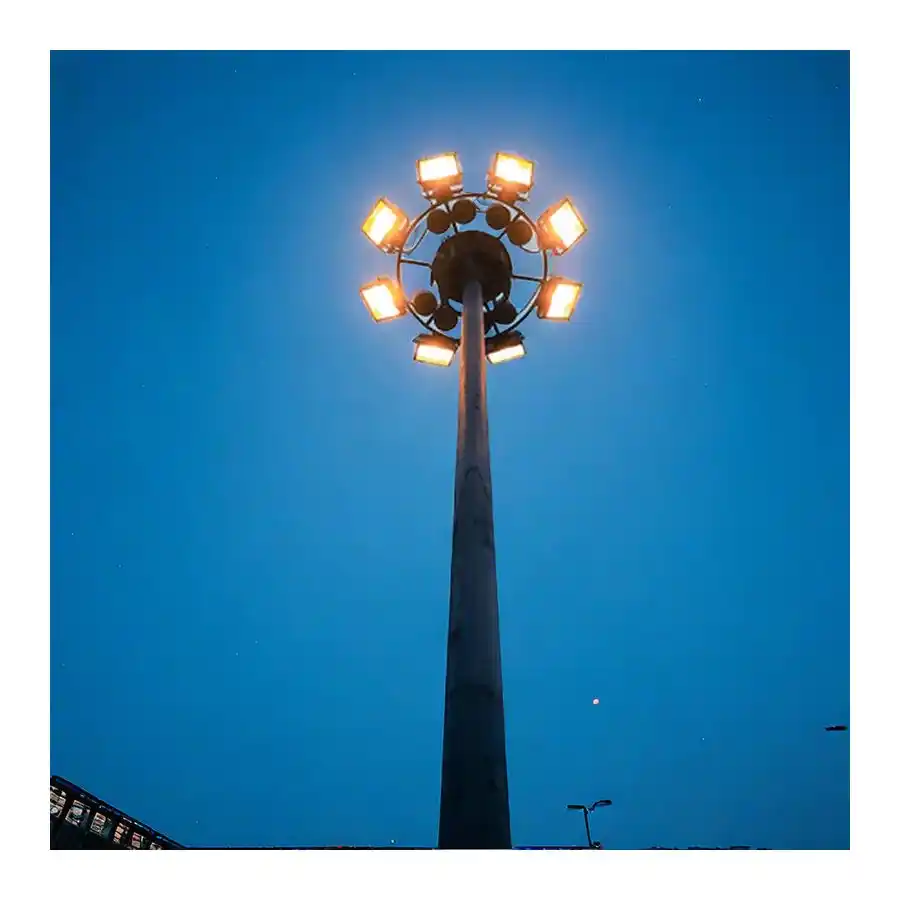
Behind every electrifying IPL match is a highly coordinated lighting system that makes this level of clarity possible, powered by strategically installed high mast towers that ensure uniform illumination and precision across the entire field.
This blog explores the engineering behind IPL stadium lighting and how optical design, electrical infrastructure, LED technology, and broadcast grade standards come together to deliver consistent, high performance illumination across the field.
Why Is IPL Stadium Lighting an Engineering System and Not Just a Set of Floodlights?
IPL stadium lighting system engineering is often perceived as a matter of installing powerful lamps for high performance sports lighting. How cricket stadium lighting works is with these parameters in balance:
- Horizontal illuminance across the turf
- Vertical illuminance toward broadcast cameras
- Uniformity across pitch, infield, and outfield
- Glare control for players and officials
- Colour fidelity and flicker suppression
- Programmable controls and scene management
- Electrical infrastructure and backup power
In practice, this ensures:
- Players can perceive depth, trajectory, and contrast accurately.
- Cameras receive consistent colour quality, near zero flicker, and high contrast.
- Spectators experience even coverage with minimal shadows.
- Umpires operate without obstruction from glare or uneven lighting.
Modern international standards such as BS EN 12193, and local adaptations through tenders like the Maharashtra Cricket Association’s broadcast grade lighting specifications, codify these requirements. High Definition and Ultra High Definition broadcasting further emphasize the need for precise, verifiable performance metrics.
What Are the Core Components of a Floodlight System in Cricket Stadiums?

High mast lighting systems in stadiums are only one component of a broadcast grade lighting system. The installation is a network of integrated elements, each serving a specific purpose.
| Component | Purpose |
|---|---|
| High masts | Elevated mounting points to achieve wide, even coverage |
| LED floodlight clusters | Deliver controlled beams to pitch, infield, and outfield |
| Precision optics | Shape beams to minimize spill and glare |
| LED drivers | Regulate current, thermal performance, and dimming |
| High voltage distribution & surge protection | Ensure stable power delivery |
| Centralized DMX control | Synchronize luminaires in programmable scenes |
| Earthing & lightning protection | Safeguard equipment and personnel |
| Standby power integration | Maintain operation during utility interruptions |
Design relies on photometric simulation, modeling thousands of light rays and angles to ensure the ball, players, and cameras receive optimal illumination. The pitch receives high vertical illuminance from multiple directions for full visibility, while outfield lighting emphasizes uniformity to avoid shadows that impair fielding. For such large scale installations, robust structural solutions like High Mast Towers by KP Green Engineering play a critical role in achieving optimal height, stability, and coverage.
What Standards Shape Sports Stadium Lighting Design for Cricket?
Sports stadium lighting design standards are key, rather than subjective brightness. Key references include:
- BS EN 12193: European standard specifying illuminance levels and uniformity for sports fields.
- CIBSE LG4 Sports Lighting Guide: LED focused guide aligned with BS EN 12193, widely referenced in India for broadcast grade cricket lighting.
Indian venues often adopt these standards through project specific tenders. For example, the MCA’s broadcast lighting requirements in cricket have to detail horizontal and vertical illuminance, ensuring uniform, measurable performance rather than approximate brightness levels.
What Lux Levels Are Required for Cricket Matches at Broadcast Standard?

Lux levels required for cricket matches are central to stadium lighting design.
- Horizontal illuminance: Light falling on the ground.
- Vertical illuminance: Light reaching balls in flight or players’ faces for cameras.
Broadcast lighting requirements cricket prioritize vertical illuminance to accommodate camera perception, which cannot adapt to uneven lighting as the human eye can.
| Zone | Horizontal Illuminance | Vertical Illuminance | Uniformity Target |
|---|---|---|---|
| Pitch | Very High (Class I) | Very High (multi camera) | ≥ 0.8 |
| Infield | High | High | ≥ 0.7 |
| Outfield | Moderate to High | Moderate | ≥ 0.6 |
Uniformity ensures consistent visibility and reduces player fatigue caused by fluctuating light.
Why Does Vertical Illuminance Matter So Much in Cricket Stadium Lighting?
Cricket involves substantial vertical ball movement, especially in T20 formats. Cameras require predictable illumination on objects moving through three dimensional space. Insufficient vertical illuminance can result in motion blur, reduced detail, and washed out highlights on slow motion broadcasts.
This requirement differentiates broadcast lighting requirements in cricket from other applications, such as warehouse or outdoor industrial lighting.
How Does Glare Control Work in Stadium Lighting for Batsmen, Fielders, and Cameras?
Glare can compromise batsmen, fielders, and cameras alike. Critical considerations with sports stadium lighting design standards include:
- Optical design to confine beam spread
- Calculated aiming angles to avoid critical sightlines
- Glare control in stadium lighting for players and cameras
Recent Indian stadium tenders specify numeric glare limits, replacing older subjective approaches and ensuring performance consistency.
Why Has LED Stadium Lighting Technology Become the Preferred Choice in India?

The shift from metal halide to LED lighting improves performance beyond just being energy efficient lighting for stadiums.
| Parameter | Metal Halide | Modern LED |
|---|---|---|
| CRI | 65–80 | 90+ |
| TLCI | Often < 80 | 90+ |
| Flicker at 50Hz | Significant | Near zero |
| Warm up time | 15 - 20 minutes | Instant |
| Dimming | Limited | Full DMX control |
| Maintenance frequency | High | Reduced |
The Television Lighting Consistency Index (TLCI) ensures colour fidelity for broadcast cameras. LEDs reliably achieve scores above 90, while legacy lamps rarely did. Instant controllability, dimming, and lower maintenance make the LED stadium lighting technology preferable in India.
What Role Do CRI, TLCI, CCT, and Flicker Play in Cricket Broadcast Lighting?
When it comes to LED stadium lighting technology in India, a few technical terms make all the difference:
- CRI (Colour Rendering Index): Shows how accurately colours appear under light. Modern LED systems score 90+, making the ball, pitch, and players appear natural on TV.
- TLCI (Television Lighting Consistency Index): Measures how cameras perceive colour. IPL stadium lighting targets 90+ for accurate broadcast capture.
- CCT (Correlated Colour Temperature): Determines warmth or coolness of light. Controlled CCT ensures uniformity and avoids colour shifts during replays.
- Flicker performance: Low flicker prevents motion blur and rolling bands in high speed cameras. Legacy metal halide systems struggled here; LEDs now deliver near zero flicker.
These parameters are often specified in MCA broadcast lighting requirements, ensuring that both players and broadcasters get optimal performance without compromise.
How Are High Mast Lighting Systems Designed for Even Coverage Across the Ground?
Designing high mast lighting system stadiums is very specific. Each mast is carefully positioned so that beams overlap and cover the entire ground evenly.
- Mast placement logic: Distance from boundaries, height, and angle are all calculated to avoid dark spots.
- Aiming strategy: Each luminaire’s orientation is planned so that pitch, infield, and outfield zones get the correct lux levels.
- Beam overlap: Reduces shadows and maintains uniformity.
- Area based lighting design: The pitch cannot be treated the same as the outfield; zones have different illuminance targets.
Uniformity is important. Uneven lighting affects both gameplay and TV broadcast quality.
How Much Power Do Stadium Floodlights Need and What Drives That Demand?
The energy consumption of stadium lighting depends on multiple factors:
- Light levels required: Broadcast grade vertical and horizontal illuminance.
- Field size: Bigger grounds require more masts or higher wattage.
- Mast height and optical efficiency: Taller masts need more power but can cover larger areas.
- Control strategy: Dimming, zoning, and programmable effects impact instantaneous power draw.
- Operating hours: T20 matches, practice sessions, and pre match setups increase energy use.
Lighting demand isn’t isolated. It’s part of the stadium’s broader electrical system, designed to handle peak loads while maintaining redundancy.
How Can Smart Lighting Systems Improve Sports Infrastructure Performance?
Modern IPL lighting isn’t just bright; it’s intelligent. Smart lighting systems sports infrastructure features include:
- Dimming and zoning: Pre match warmup or low intensity practice without manually adjusting each luminaire.
- Scene control: Interval celebrations, player entrances, and broadcast effects programmed in advance.
- Maintenance alerts: Driver units report degradation before visible performance drops.
- Operational flexibility: Switch between practice, broadcast, or event lighting in seconds.
DMX enabled control ties everything together, connecting LEDs, power systems, and broadcast operations seamlessly.
How Do Engineers Balance Brightness with Energy Efficiency in Stadium Lighting?
Engineering energy efficient lighting for stadiums isn’t about blinding intensity. It’s about the right light, in the right place, efficiently:
- Optical efficiency: Precision lenses focus light only where needed.
- Efficacy: LEDs deliver more lumens per watt than legacy lamps.
- Controls: Dim and zone lights to save energy without affecting broadcast.
- Maintenance factor: Accounting for lumen depreciation ensures consistent long term performance.
The goal is maximum visibility and broadcast quality with minimum wastage.
Why Do Backup Power and Reliability Matter So Much in IPL Night Matches?
IPL lighting is mission critical infrastructure. Live matches reach millions; a failure isn’t just inconvenient, it’s a broadcast disaster. Systems must include:
- Redundant mast coverage: One mast failure doesn’t leave dark spots.
- Fast switch backup power: LEDs light instantly; no 15 - 20 minute warm up needed like metal halide.
- Monitoring systems: Detect faults before they interrupt play.
Lighting reliability is part of a larger stadium risk management system.
What Should a Modern Engineering Checklist for IPL Stadium Lighting Include?
For anyone curious what separates a professional installation from a basic one:
- Targeted lighting: Horizontal and vertical illuminance for pitch, infield, and outfield.
- Uniformity: Consistent light within and across zones to avoid shadows.
- Glare control: Limits for players’ sightlines and broadcast cameras.
- Colour fidelity: CRI and TLCI above 90 for accurate colours on TV and on field.
- Flicker free: Smooth motion capture for HDTV and slow motion replays.
- Controlled colour temperature (CCT): Consistent appearance across the field.
- Precision placement: Mast positions and aiming modeled with software.
- Smart control: DMX enabled scenes and zone management.
- Commissioning checks: Measurement based verification post installation.
- Maintenance planning: Accounts for LED driver life and lumen depreciation.
Following these parameters ensures the system meets broadcast lighting requirements in cricket demands, and players and spectators experience a high quality match.

Final Takeaway: Why IPL Stadium Lighting Works So Well at Night
From LED stadium lighting technology in India to smart DMX control, precision optics, and redundant power, modern IPL lighting combines optical design, structural planning, control intelligence, and electrical reliability.
IPL stadium lighting isn’t about wattage or intensity; it’s about performance. And that performance is measured in lux, uniformity, glare, CRI, TLCI, flicker, and player safety, all working together to create one of cricket’s most important, yet often overlooked, spectacles.
Frequently Asked Questions:

About Us
KP Green Engineering Ltd. provides complete engineering and steel structure manufacturing solutions worldwide, serving industries such as renewable energy, telecommunications and beyond.
Get In Touch

Transmission Line Towers

Windmill Lattice Towers
Telecom Towers
Substation & Switchyard Structures
High Mast Towers
Mono Pole Towers
Solar Module Mounting Structures
Solar Trackers

Pre-Engineered Building
Cable Trays
Perforated Cable Trays

Ladder Type Cable Tray

Crash Barriers
Electrical Isolator

Double Break Isolator/Disconnector
Galvanized Earthing Strips and Flats

Solar Rooftop Solutions
Latest News
Rs 272 Crore Orders! This Green Energy Engineering Stock Wins Contracts Across 3 Key Businesses
KP Group Raises FY32 Ambitions with KP 3.0, Targets 10 GW Each in Owned Generation and EPC
KP Group’s listed renewable businesses post strong multi year growth on the back of disciplined capital allocation, operational efficiency
Recently Uploaded Blogs


